
NSW Government Air Conditioning Rebates: How to Reduce the Cost of Upgrading Your Air Conditioner
With electricity costs putting pressure on household budgets, improving the energy efficiency of your home can be an effective way to reduce long-term energy consumption. For NSW households considering a new air conditioner, there are currently government-supported incentives that may help reduce the upfront cost of upgrading.
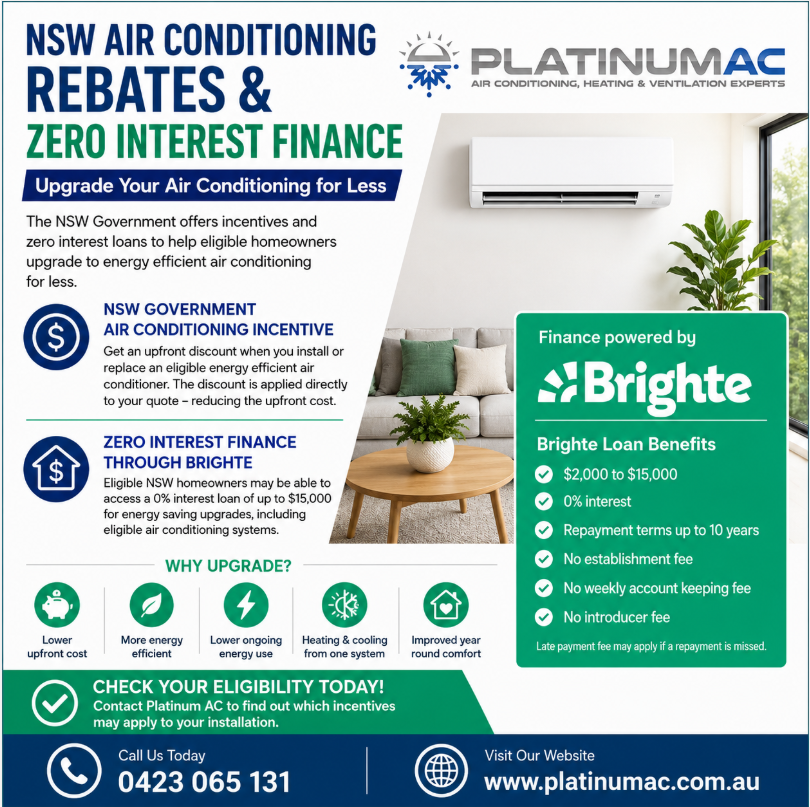
The NSW Government Air Conditioner Upgrade Incentive, delivered through the Energy Savings Scheme (ESS), provides eligible households and small businesses with an upfront discount when installing a qualifying energy-efficient air conditioner or replacing an older system with a more efficient model.
There is also the NSW Government Home Energy Saver program, which currently offers eligible homeowners and landlords access to zero-interest loans of up to $15,000 for approved energy-saving improvements, including eligible reverse-cycle air conditioning. A separate Home Energy Saver discount of up to $4,000 has been announced, but as of September 2026, NSW Government information states that applications for this discount are coming soon.
Understanding how these programs differ is important before purchasing a new air conditioning system.
What Is the NSW Air Conditioner Upgrade Incentive?
The Air Conditioner Upgrade Incentive operates through the NSW Government's Energy Savings Scheme.
It is intended to encourage NSW households and small businesses to replace inefficient heating and cooling equipment or install more energy-efficient air conditioning.
Unlike a traditional rebate where you purchase something and subsequently lodge a claim to receive money back, this incentive is generally provided as an upfront discount included in the installation quote.
The NSW Government currently lists the incentive as available now with no current closing date.
This means eligible customers can reduce the initial cost of their new system rather than waiting to receive a reimbursement after installation.
How Much Is the NSW Air Conditioning Discount?
There isn't one fixed rebate amount that applies to every air conditioner.
According to current NSW Government examples, the discount can be:
- Up to $550 when installing a new 6kW air conditioning system.
- Up to $560 when replacing an old air conditioner with a 6kW split system.
These figures are indicative rather than guaranteed.
The actual incentive can vary according to factors such as the air conditioner selected, its capacity and efficiency, whether an existing system is being replaced, the installation circumstances and scheme requirements.
Installation costs themselves can also vary because of property design, additional building work, travel, administration and compliance costs, and the installer selected.
This is why homeowners shouldn't select an air conditioner simply because it appears to generate the largest government incentive.
The most appropriate system should balance capacity, efficiency, installation cost, reliability and suitability for the property.
Which Air Conditioners Can Qualify?
Not every air conditioner is eligible.
The NSW Government encourages the installation of energy-efficient systems that deliver measurable energy savings.
Eligible installations can include new air conditioners as well as replacements for older, less efficient equipment. Current NSW information also indicates that eligible reverse-cycle split systems and ducted systems may qualify.
Importantly, changes introduced in 2026 expanded relevant Energy Savings Scheme air-conditioning activities to include multi-split systems and updated requirements applying to air conditioners.
Because eligibility can vary between products, homeowners should have the specific model checked before committing to an installation.
Why Is the NSW Government Encouraging Air Conditioning Upgrades?
Heating and cooling can represent a significant component of household energy consumption.
Modern reverse-cycle air conditioners can provide efficient heating as well as cooling, allowing one system to perform both functions.
The NSW Government identifies several potential advantages of upgrading, including lower ongoing energy costs, reduced maintenance costs with newer equipment and lower emissions. Eligible energy-efficient systems may also provide improved indoor air quality through filtration of dust, allergens and pollutants
For homeowners replacing very old or inefficient heating and cooling equipment, the long-term benefit can therefore extend beyond the initial government discount.
How Do You Claim the Air Conditioning Incentive?
One of the most important things to understand is that you generally shouldn't purchase and install an air conditioner and then expect to claim the incentive afterwards.
The process starts before installation.
The NSW Government recommends obtaining multiple quotes from installers offering the incentive and checking that the applicable discount is shown in the quote.
Once you've selected the system and installer, you'll need to complete the required documentation.
Your installer provides a nomination form that must be signed and returned so they can secure the discount under the scheme.
Crucially, this documentation must be completed before installation begins. The NSW Government states that customers won't be reimbursed under this incentive for work that has already been completed.
This makes checking eligibility before proceeding especially important.
NSW Home Energy Saver: Another Option for Air Conditioning
The Air Conditioner Upgrade Incentive isn't the only NSW Government program that can help households upgrade their heating and cooling.
The newer Home Energy Saver program provides financial assistance for a broader range of household energy improvements.
Current eligible technologies include reverse-cycle air conditioning as well as rooftop solar, batteries, heat-pump and solar hot water systems, switchboard upgrades, induction cooktops, DC ceiling fans, insulation, draught proofing and double glazing.
The program has two forms of assistance: discounts and zero-interest loans.
However, their availability currently differs.
As of September 2026, Home Energy Saver loan applications are open, while the NSW Government says applications for its separate discounts of up to $4,000 are coming soon.
Zero-Interest Loans of Up to $15,000
For households concerned about paying the remaining cost of an air conditioning upgrade upfront, the Home Energy Saver loan may be particularly useful.
Eligible homeowners and landlords can access a zero-interest loan of up to $15,000, repayable over a maximum term of 10 years, for approved upgrades.
Participating finance providers include Brighte and Plenti.
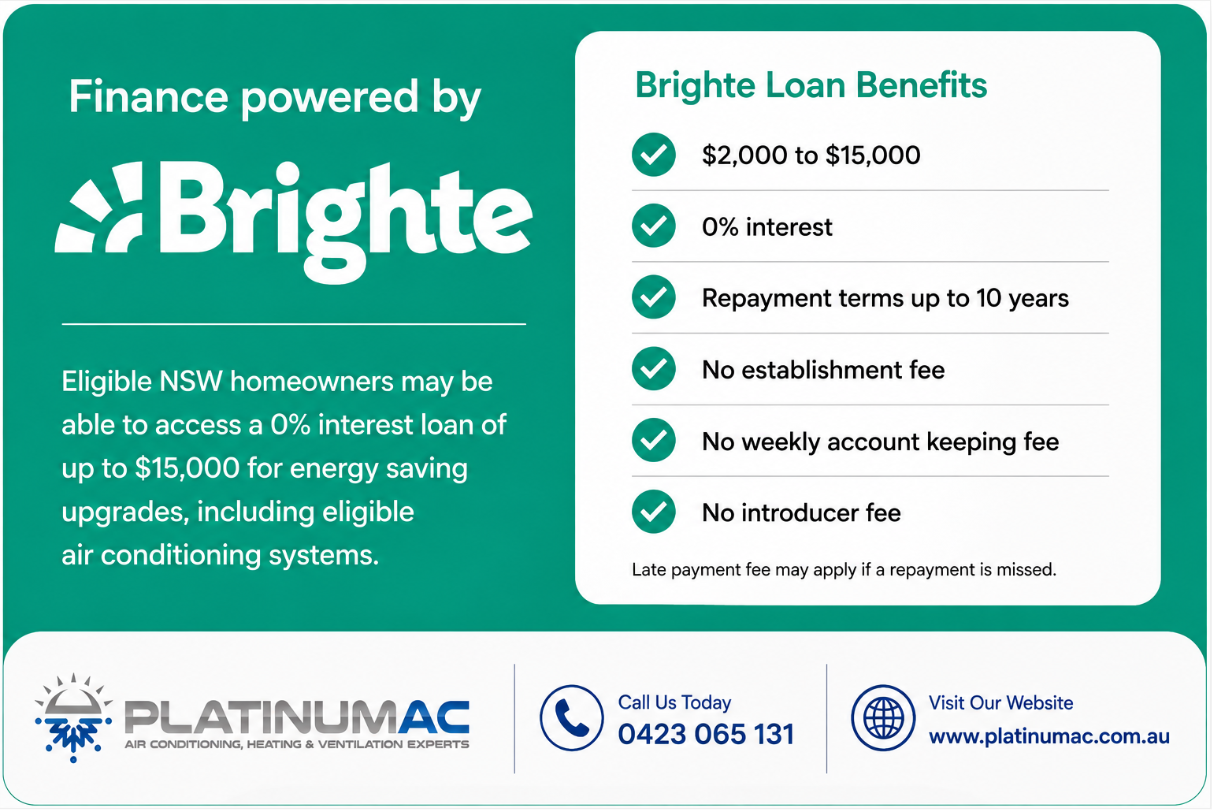
Under Brighte's current Home Energy Saver offering, approved customers can borrow from $2,000 to $15,000 at 0% interest, with repayment terms of up to 10 years. Brighte currently lists no establishment fee, weekly account-keeping fee or introducer fee, although a late-payment fee may apply when repayments are missed.
The important distinction is that this is finance, not a rebate or grant. The amount borrowed must be repaid.
Who Can Apply for a Home Energy Saver Loan?
The Home Energy Saver loan has different eligibility requirements from the general Air Conditioner Upgrade Incentive.
For the current Brighte-delivered loan, applicants may be eligible when:
- The property is located in NSW.
- They are the homeowner or landlord.
- They are an Australian citizen or permanent resident.
- Combined household taxable income doesn't exceed $210,000 per year.
- The property isn't social housing.
- The property isn't being used for short-stay accommodation.
- They meet the lender's credit assessment requirements.
The proposed upgrade must also satisfy the Home Energy Saver program requirements.
Finance isn't guaranteed. Applications are subject to assessment and approval by the participating finance provider.
Can You Combine Government Assistance?
Potentially.
The NSW Government says that eligible households can receive both a Home Energy Saver discount and loan together once both forms of support are available.
There are also existing Energy Savings Scheme incentives for air-conditioning upgrades.
Because these programs have separate eligibility, product and administrative requirements, homeowners shouldn't assume that qualifying for one automatically means they qualify for another.
The safest approach is to have the proposed system, installation and available assistance checked before signing contracts or commencing work.
Split System or Ducted Air Conditioning?
Government incentives shouldn't determine whether you install a split system or ducted system.
The decision should primarily depend upon the property and how it needs to be heated and cooled.
A reverse-cycle split system may be suitable when you're primarily conditioning one living area, bedroom or another defined space.
Ducted air conditioning may be more appropriate when heating and cooling several rooms or larger areas through one integrated system.
The NSW Government specifically notes that eligible reverse-cycle split and ducted air conditioners may qualify for its programs, subject to the applicable requirements.
Why Energy Efficiency Matters
When comparing systems, purchase price is only one consideration.
An inexpensive air conditioner that is incorrectly sized or inefficient may ultimately cost more to operate.
An appropriately sized energy-efficient reverse-cycle system can potentially reduce electricity consumption while maintaining comfortable indoor temperatures.
Energy efficiency also influences the Energy Savings Scheme incentive. The NSW Government explains that not all eligible air conditioners of the same capacity receive the same discount and that more efficient models can provide a larger installation discount and greater long-term energy savings.
This makes professional system selection particularly important.
What Should Homeowners Do Before Upgrading?
Before purchasing a new air conditioner, determine which areas of the property need heating and cooling and whether a split, multi-split or ducted system is most appropriate.
Then obtain quotes from installers participating in the relevant incentive program.
Ask the installer to identify the exact air conditioning model, confirm whether it meets the applicable requirements and clearly show any government incentive on the quote.
Complete all required documentation before installation begins.
If you're considering Home Energy Saver finance, check your eligibility separately and remember that finance applications remain subject to credit approval.
Most importantly, don't assume that advertisements referring broadly to a "government rebate" mean every homeowner will receive the same amount.
Making Air Conditioning More Affordable in NSW
The NSW Government's current energy-efficiency programs can make upgrading an air conditioner considerably more accessible for eligible households.
The Air Conditioner Upgrade Incentive can reduce the initial installation price through an upfront discount, while the Home Energy Saver loan can allow eligible homeowners and landlords to finance approved reverse-cycle air conditioning and other energy-saving upgrades with loans of up to $15,000 at zero interest.
For households planning an upgrade, the key is to investigate eligibility before the air conditioner installation, compare appropriate energy-efficient systems and understand exactly which incentive or finance program applies.
With the right system and professional installation, the benefit isn't simply a lower upfront cost. An efficient reverse-cycle air conditioner can provide reliable year-round heating and cooling while potentially reducing long-term household energy consumption.
Important: Government schemes, eligibility criteria, product requirements and incentive amounts can change. Check the latest NSW Government information and confirm eligibility with an approved participating provider before purchasing or installing equipment.
Contact Platinum AC for any enquiries regarding the NSW Government air conditioning rebates. Tel - 0423 065 131